
What to Know About Industrial Waste Disposal

Industrial waste disposal gets easier once you know which materials are regulated and how much everyday trash your facility generates in a typical week. You’ll size the container and set pickup days from those two answers.
Failing to plan properly can result in a rejected load at the landfill or a roll-off spilling over by midweek.
Sort Waste Streams Before Choosing a Disposal Method
Under Virginia Department of Environmental Quality (DEQ) rules, the business that made the waste must determine whether any of it is hazardous. The state borrowed most of its program from federal standards set by the U.S. Environmental Protection Agency (EPA). Ordinary solid debris can usually go in a roll-off; special and hazardous material has to be handled separately.
Nonhazardous Solid Waste
Busted pallets, cardboard, stretch wrap, wood offcuts, scrap metal, and packaging foam usually make up the bulk of what leaves a plant or warehouse floor. If a renovation or tear-out is happening on site, add concrete and drywall to that list.
Nearly all of it can go in a roll-off dumpster, as long as nothing regulated gets mixed in. Under the state’s solid waste rules, Virginia’s industrial landfills are only permitted to take nonhazardous material. One contaminated drum in the load can get the whole thing turned around at the scale house. Clean cardboard and scrap metal kept out of the mixed pile can often go to a recycler.
Special and Hazardous Materials
DEQ classifies tires, discarded electronics, and similar items as special waste, which needs specific processing or handling before disposal. Spent solvents, paint thinners, batteries, and some process sludges may qualify as hazardous.
Federal rules group generators of that waste by monthly output. A shop producing no more than 100 kilograms (roughly 220 pounds) in a calendar month is a very small quantity generator. A facility producing 1,000 kilograms or more counts as a large quantity generator.
How long you can store it on site, and how much paperwork goes with each shipment, depends on that classification. Even at the smallest level, hazardous waste has to go to someone authorized to manage it. Tossing a drum of spent solvent into a general debris roll-off doesn’t meet that standard.
Plan Industrial Waste Management from the Workstation to the Truck
Inside the plant, managing industrial waste comes down to three jobs: collection, containment, and pickup timing. Handle them well, and you get floor space back and are less likely to pay for hauls you didn’t need.
Collection is mostly about bin placement. Put one beside the cutting station, another at the end of the packaging line, and one by the receiving dock, where pallets and stretch wrap stack up fastest. Crews tend to sort when the right bin is a few steps away; if it’s across the building, everything lands in whatever container is closest.
Containment problems at the outdoor roll-off usually stem from overfilling, since material above the rim can fall onto forklift lanes and wind can carry loose packaging into a storm drain. In Virginia Beach, water in the drainage system flows into nearby creeks and rivers without treatment, per the city’s Public Works department. Tarping the container at shift change and booking the haul before the load reaches the rim can prevent both.
Pickup timing depends on fill rate. A manufacturer topping off a 30-yard roll-off every few days typically opts for recurring commercial service. On-call hauls might be a better fit for a warehouse that fills one a month. A facility manager who records the day each container is full, for three or four weeks, has real numbers to build a schedule around.
Size the Dumpster for Weight as Well as Volume
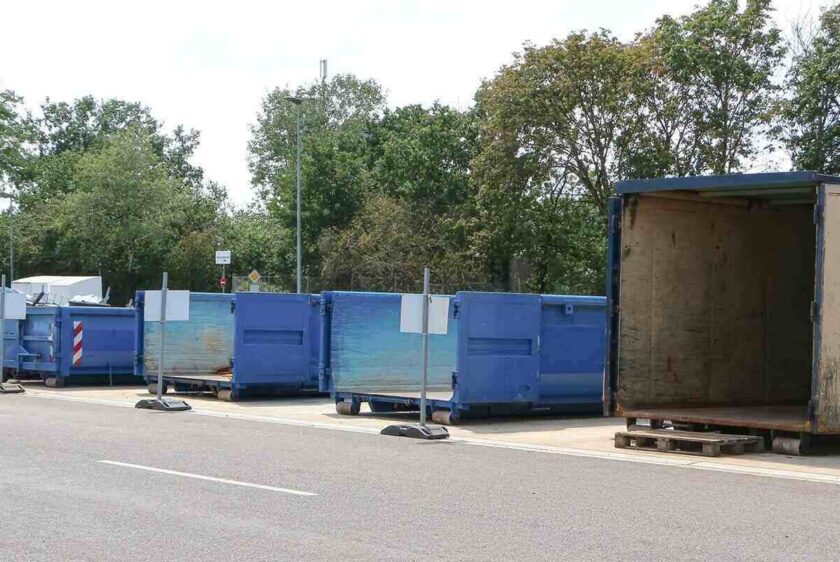
A 20-yard roll-off holds 20 cubic yards of loose debris. Weight has its own cap, and with concrete, brick, or scrap steel, you can hit it while the pile is still well below the rim.
Go over the tonnage limit (the heaviest load allowed in the container), and you may pay an overage charge. Limits and banned-item lists change from one provider and landfill to the next, so get both in writing before delivery day.
A load of pallets, foam, and stretch wrap is mostly air, so the roll-off can look full and still weigh very little. For a one-room renovation or pulling out a single machine, a smaller container usually holds everything. Full demolition produces debris that’s both heavy and bulky.
When you’re torn between two sizes, order the larger one so there’s room for material that comes out bulkier than you planned. This dumpster sizing guide has a side-by-side comparison of all three.
If you’re working inside a running plant, write the container size and the material rules into your waste management plan. That way each crew knows what can go in the roll-off. Keep a copy with the site superintendent, too, in case an inspector asks how regulated items were removed.
Get Industrial Waste Removal on a Schedule That Fits Your Plant
Full Strut Disposal handles industrial waste removal for manufacturers, warehouses, and contractors across Virginia Beach and the rest of Hampton Roads, with roll-off rentals and recurring commercial collection. Call our dispatch office and walk us through what your floor throws away in a normal week. We’ll help you pick a container size, set a pickup schedule, and check which materials are accepted before drop-off.
We take on-time hauls seriously, because one missed haul at a plant can leave an overflowing roll-off parked in front of a dock door. Debris that’s contained and hauled on schedule is less likely to wash into the creeks and rivers draining to the Hampton Roads coastline. Contact us online or call 757-805-5749 to set up containers and pickups for your facility.


